

$396.30. That's what you pay to collect one $12,000 roof when the homeowner pays a Square invoice by card on Square's free plan, as of November 2026, and that's one job.
I get it, customers expect to pay by card now. But the contractor payment solutions worth having do two things for you: they get you paid on big tickets without handing 3% or more of each one to a processor, and they keep your deposit money from getting stuck.
When a contractor gets on a call with me, we start by pulling last month's statement and finding the real rate (what you actually paid in fees, divided by what you processed). So that's what this guide does, method by method.
TL;DR
- A $12,000 card payment on flat-rate pricing costs you about $312 to $420, depending on how the card gets taken.
- ACH and checks cost far less per job, so put them on every big invoice and make them the easy choice for your customer.
- Deposits and progress payments are sales for work you haven't done yet, and that's exactly what a bank's risk team watches.
- Adding a "3% card fee" to an invoice is a surcharge with its own rules, while posting a card price and a lower ACH or check price on the estimate is dual pricing.
- In the illustration below, a contractor billing $80,000 a month goes from $2,183.60 to $818.60 in monthly processing cost on Noomerik's published rates, before standard merchant account fees.
Separate Getting Paid From Paying Your Subs
"Contractor payment solutions" covers two very different jobs, and quite honestly, the tools barely overlap.
- Getting paid by your customers. Homeowners and commercial clients paying you for finished work. That's card processing, ACH, and invoicing (the money coming in), and it's what this guide covers.
- Paying your own crew and subs. Sending money to 1099 workers and subcontractors and handling their tax forms at year-end. That's payroll or accounts payable software (the money going out), a different category with different vendors.
If you came for the second one, sorry, wrong aisle (the search results mix the two together, so it's an easy mistake to make). But if you're the one sending the invoice, keep reading.
Compare the Six Ways Contractors Get Paid
Every method below moves the same money, from your customer's bank to yours. What changes is who pays to move it and how fast it lands in your account.
I'm using Square's published free-plan prices as of November 2026, because a lot of contractors start on Square (it's easy to set up, and that can't be argued), and those prices give you a fair yardstick for any flat-rate app.
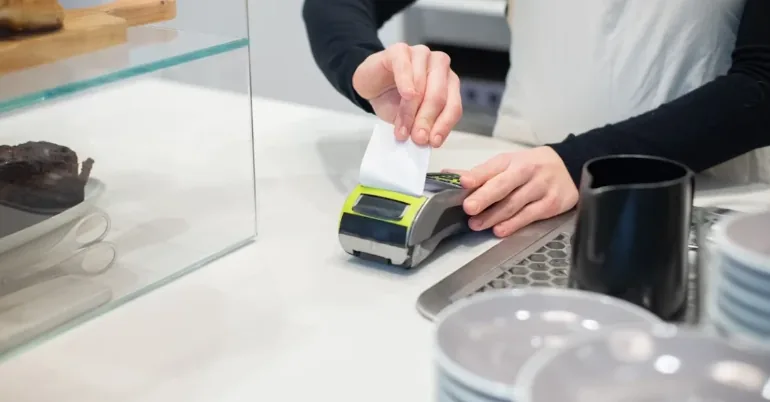
- Card, tapped or inserted on site. The cheapest way to take a card, because the card is physically there for the bank to see. Square lists 2.6% plus 15 cents for in-person payments, which suits the service calls you finish in one visit.
- Card through an invoice link. Your customer pays from an email or a text, which is convenient for everybody. But you pay for that convenience: 3.3% plus 30 cents on Square's free plan.
- Card keyed in over the phone. Your office types the card number into a virtual terminal (a payment screen in your web browser). Square lists 3.5% plus 15 cents for manual entry, the highest of the three, since a keyed card is a card-not-present sale.
- ACH bank transfer. Your customer's bank sends the money straight to yours over the ACH network (the Automated Clearing House, the same system behind direct deposit and online bill pay). Square's free plan charges 1% with a $1 minimum on invoice ACH, and its paid plans cap that fee at $10.
- Paper check. No processing fee at all, which sounds great. But you pay for it in other ways, with mail time and the days before the money is actually usable.
- Person-to-person apps. Zelle, Venmo, and the like were built for paying your friends, and their business features vary by app and by bank. I'd use one for a $150 repair from a neighbor, but never for a $15,000 job, because you're relying on an app's terms instead of a merchant agreement.
Price Out a $12,000 Job by Payment Method
Here's one mid-size job, a $12,000 roof replacement, run through each method at the same Square free-plan rates. Your own processor's numbers will be different, so swap them in and do the math yourself.
| How the customer pays | Rate | Cost on one $12,000 job | Cost on 10 jobs a year |
|---|---|---|---|
| Card tapped on site | 2.6% + $0.15 | $312.15 | $3,121.50 |
| Card through an invoice link | 3.3% + $0.30 | $396.30 | $3,963.00 |
| Card keyed in by phone | 3.5% + $0.15 | $420.15 | $4,201.50 |
| ACH through an invoice | 1% ($1 minimum) | $120.00 | $1,200.00 |
| Paper check | No processing fee | $0.00 | $0.00 |
The spread between the cheapest card method and the priciest is $108 on a single job. Between a keyed card and ACH, the gap is $300.15, or $3,001.50 across ten jobs, and that's money walking out the door every year.
That's not a rounding error. So the first fix costs you nothing. Offer ACH on every estimate and invoice, and take cards in person whenever you can.
Plan for Holds on Big Tickets and Deposits
Most of the guides ranking for this search skip this part. If you've "never had a problem" with a hold, good, but for a contractor this matters more than the rate.
Quick-start payment apps, Square included, generally run on the payment facilitator model (PayFac for short). A payment facilitator signs you up as a "sponsored merchant" under its own agreement with an acquiring bank (the bank that settles card sales), and it receives your settlement money before passing it along, as Visa's payment facilitator overview describes.
That's why you can be taking cards by lunch. But the same setup works a lot like a sublet, where you live under somebody else's lease, and their rules decide when your money moves.
So ask yourself, "What does my business look like to a risk team?" Here's the honest answer.
- Big tickets. In the risk check I walk agencies through, a ticket over $500 is one of the flags. Most contractor invoices clear that before the materials even show up.
- Money now, work later. A deposit on a kitchen that starts in six weeks is a sale for future delivery. The OCC's merchant processing handbook (the OCC is the Office of the Comptroller of the Currency, the federal regulator for national banks) notes that chargeback risk runs higher on those sales, since disputes tend to surface only once the work comes due, and that banks cover it with holdback reserves, funded either in one amount up front or by keeping back part of every day's sales.
- Sudden jumps. The same handbook describes banks delaying settlement when fraud staff sees a transaction as suspicious or unusual. Three roofs in one week after a slow month can look "unusual" to a system that doesn't know it's spring.
Sorry, I know nobody wants to hear that about money they've already earned. None of that is personal; a bank will always protect itself first. I like to explain chargebacks as being like your credit score, and the way contractors bill puts more weight on that score than most businesses ever feel.
So who reviews you, and when, matters. An underwritten merchant account lowers the chance of a surprise hold, because the bank reviews your business before you process. Any bank can still hold funds under its risk policies.
When you apply with Noomerik, the bank asks for three months of business bank statements and your recent processing statements, and it reviews all of that before your first sale runs. Answering those questions up front beats answering them on a Friday afternoon while a $20,000 deposit sits in limbo.
Set Up Deposits and Progress Payments That Hold Up
A clean payment schedule protects you twice, once with the homeowner and once with the bank. Think of it like framing (see what I did there): get it square at the start, and everything after it goes faster.
1. Check Your State's Deposit Limit
Some states cap what you can collect up front on home improvement work. California is the well-documented example, where the down payment is capped at the lesser of $1,000 or 10% of the price, and each later payment can't run ahead of the work done and materials delivered, according to a Contractors State License Board bulletin.
Deposit rules vary from state to state, so look yours up before you set an amount, and bring in a lawyer if a contract has unusual terms.
2. Write the Payment Schedule Into the Contract
Name each payment, what it covers, and the milestone that triggers it. A homeowner who signed off on "$4,000 when the cabinets are delivered" is going to have a hard time disputing $4,000 on the day the cabinets show up.
3. Bill Each Draw When That Stage Is Finished
Send every progress payment as its own invoice, tied to the stage it pays for. Matching each charge to finished work keeps you in line with rules like California's, and it gives every card charge its own clean record if anybody ever asks.
4. Get Sign-Off Before You Run the Card
A text that says "rough-in passed, go ahead and charge the second draw" takes the homeowner about ten seconds to send. But if that charge is ever questioned, that text is the most useful thing in your file.
5. Keep a Complete File for Every Job
Hold onto all of this until well after the final payment clears:
- The signed contract and every change order.
- Photos of the work at each stage.
- Inspection results.
- The customer's written approvals for each draw.
A chargeback happens when the cardholder's bank (the issuing bank, the one that gave your customer the card) reverses a sale, and you answer it with evidence. So the contractor with the complete file is the one in a position to answer.
Price Card Costs Into the Estimate Instead of Adding a Fee
Here's where plenty of contractors get into trouble. They type "3% for credit cards" at the bottom of the invoice and figure it's handled.
I get it, a 3% line looks like the simplest fix in the world. But that line is a surcharge, and surcharges come with their own rules. Visa's merchant surcharging questions and answers lay out several of them:
- Credit only. A surcharge can apply to credit cards, and debit and prepaid cards can't be surcharged, period.
- Notice first. Your acquirer needs 30 days' warning before your first surcharged sale.
- Disclosure up front. The surcharge has to be disclosed before the customer pays and shown again on the receipt.
- Not everywhere. Visa's own guidance says surcharging is open to merchants in "most" states, which means some states don't allow it at all.
Dual pricing works the other way around. You post two prices before your customer pays anything.
One is a card price, and the other is a lower price for paying by debit, ACH, or check. Under Visa's guidance, a discount like that holds up when the card and cash prices sit next to each other (or only the card price is shown), and the card total is never built by tacking a fee onto the bill.
On an estimate, it can be as plain as two lines:
- Roof replacement at the card price, $12,420
- Roof replacement at the debit, ACH, or check price, $12,000
Gas stations have done this for decades, with two prices right there on the sign. You pick your lane, and so does your customer.
Dual pricing, set up as a discount for paying by cash or debit, is allowed in all 50 states. Federal law stops card issuers and card networks from blocking those discounts, and some states add their own display rules, so both prices have to be posted where customers see them before they pay. Puerto Rico, which is not a state, prohibits price differences by payment method.
Noomerik builds its dual pricing setup to follow card brand rules and the law in all 50 states. Posting both prices on your shelves, menus, website, and invoices is still your job. For a contractor, both totals belong on the estimate and on every invoice that follows it.
Some processors sell a "cash discount" program. It is a different setup. Dual pricing discounts from a posted card price and adds nothing at checkout. State rules on displaying two prices aren't uniform, so check your setup with your processor and run anything unusual past an attorney.
Match the Setup to Your Monthly Volume
Dual pricing pays off fastest for businesses processing well into five figures a month; very low volumes may do better on a flat-rate processor. There is strategy in payments, and here's how I'd think about it by stage:
- Around $10,000 to $15,000 a month. Keep costs low and keep it simple. A flat-rate app with ACH on the bigger invoices is fine, and I'd tell you the same thing on a call.
- About $25,000 to $75,000 a month. Start treating payments like tax strategy, because the card percentage is now a real line on your profit and loss statement.
- $100,000 a month and up. Every point of card cost turns into a five-figure number by year-end, so the setup deserves as much attention as your insurance.
To see the middle of that ladder in dollars, take a contractor billing $80,000 a month across 16 jobs. Half the dollars come in by credit card, and the other half splits evenly between debit cards and ACH. The table below is an illustration using Noomerik's published rates, set against Square's free-plan invoice rates from November 2026.
| Cost line | Flat-rate invoices (Square free plan) | Dual pricing (Noomerik Growth plan) |
|---|---|---|
| Monthly platform fee | $0.00 | $159.00 |
| 8 credit card jobs, $40,000 | $1,322.40 (3.3% + $0.30 each) | $2.40 ($0.30 each) |
| 4 debit card jobs, $20,000 | $661.20 (3.3% + $0.30 each) | $351.20 (1.75% + $0.30 each) |
| 4 ACH jobs, $20,000 | $200.00 (1%) | $306.00 (1.50% + $1.50 each) |
| Monthly total | $2,183.60 | $818.60 |
| Yearly total | $26,203.20 | $9,823.20 |
So you're looking at $1,365 a month, or $16,380 a year. Before you get excited, here are the honest limits on that number:
- Merchant account fees. Standard merchant account fees still apply on top of the dual pricing column, and they vary by bank.
- The ACH line goes up. Noomerik's ACH costs more per job than a flat 1%, so if most of your big jobs already pay by ACH on a capped plan, dual pricing changes less for you.
- Card customers pay more. Anyone paying by card pays the higher posted price, and that price is what covers the card percentage. Some will switch to ACH or check, and that's their call to make.
Noomerik's published pricing, as of November 2026, comes in three listed plans plus a custom Enterprise tier:
- Starter, $99 a month. The core dual pricing setup and virtual terminal.
- Growth, $159 a month. Adds Expedited ACH at 1.50% plus $1.50, and invoicing and subscriptions in HighLevel.
- Scale, $199 a month. Adds a dedicated account manager and priority onboarding.
On all of them, a credit card sale costs you 30 cents (the posted card price covers the percentage), and a debit sale costs 1.75% plus 30 cents. Standard merchant account fees still apply.
Noomerik says merchants typically cut their net processing cost by 50 to 90%, depending on how many customers pay by debit or cash. For a contractor, the pieces that matter most are these:
- A virtual terminal for phone payments, included with every plan.
- Physical card terminals for the truck or the kitchen table, at an extra cost.
- The HighLevel payment app, which handles invoices and payment links if you run your business in HighLevel.
- U.S.-based support.

Frequently Asked Questions
Short answers to the questions that come up once the numbers are on the table.
Should I take credit cards on a $20,000 job?
Yes, as long as the estimate already accounts for the cost. At a 3.3% plus 30 cents invoice rate, a $20,000 card payment costs you $660.30, so either post a card price that covers it or point the customer to ACH or check. Quietly eating that on every big job is the most expensive habit in this whole guide.
Will my card processor send me a Form 1099-K?
Yes. According to the IRS guide to Form 1099-K, a card processor sends one for card payments no matter how many you took or how much they totaled, while payment apps and online marketplaces report once you pass $20,000 across more than 200 transactions. Your CPA can tell you how it lines up with your books.
How fast does a card payment reach my bank account?
That depends on the processor. On Noomerik, funding is two business days or the next business day, based on the daily 5 p.m. Eastern cutoff.
Can my office take a card payment over the phone?
Yes, through a virtual terminal, and Noomerik includes one with every plan. But keyed payments cost you more on flat-rate pricing (Square lists 3.5% plus 15 cents for manual entry), so send a payment link or offer ACH when your customer can pay that way.
What happens if a homeowner disputes a card payment?
The homeowner's bank reverses the sale as a chargeback, and you respond with evidence through your processor. Your signed contract and the customer's written approval for each draw carry the most weight. A pattern of disputes can lead a bank to hold funds or close the account, so the paper trail matters long before anything goes wrong.
Final Thoughts
Getting paid as a contractor comes down to two questions. What does each method cost on your real job sizes, and how likely is that money to sit in limbo once you've earned it?
Most of the answer is plain. Take cards in person and offer ACH on the big invoices. Tie every draw to finished work, and put the card cost into the estimate where your customer can see it.
So pull last month's statement, divide your total fees by your total card volume, and compare that rate with the tables above. Make sense?